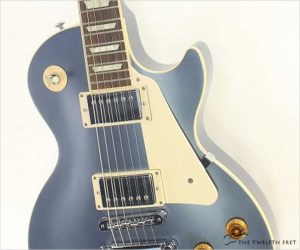
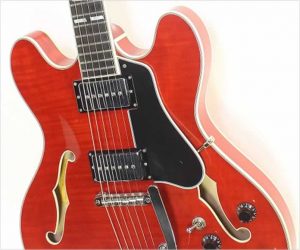
The Eastman T486B Thinline is an excellent take on the classic semi-hollow design introduced by Ted McCarty, president of Gibson, with the 1958 ES-335. Like most other versions of this design, the Eastman T486B uses pressed Maple Laminate for the top, back and sides, with a Maple block running down the center of the body. The top has a pair of F holes, and here they are bound. On the Eastman, the neck is Maple with a bound Ebony fingerboard sporting Split Block Parallelogram inlays (similar to an ES-345).
Maple
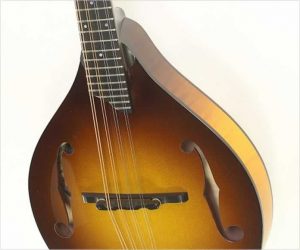
The Collings MT A Style mandolin is the entry point for Collings mandolins, and its lack of decoration doesn’t hide the quality of the instrument or the care with which it was built. The A Style mandolin appeared in the closing days of the 19th century as part of Orville Gibson’s revolutionary introduction of violin making principles to mandolin construction. The results were such a dramatic improvement that the centuries old European bowl-back design almost died out in short order.
This instrument has sold
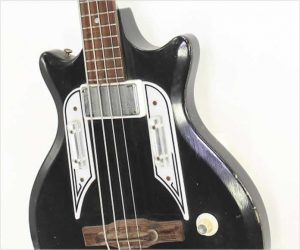
MORE →Here is a rarity, an Airline Pocket Bass by Valco, Black dating to 1964, a short scale bass regarded by some as one of the best recording basses ever made. The Airline Pocket Bass was built from 1962 to 1968 at the Valco shops in Chicago, Illinois, along with other Valco brands including National and Supro. Valco also branded their instruments for other companies, many of which were distributors or catalog retailers like Montgomery-Ward and Sears Roebuck. Valco amplifier production followed the same pattern but their customers included established builders like Harmony, Gretsch and Kay.
This instrument has sold
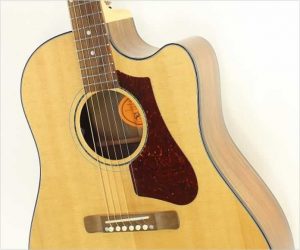
MORE →Part of the High Performance series introduced for the 2017 model year and currently out of production, the Gibson HP 415 CEX pairs a Sitka Spruce top and Black Walnut for the sides, back, rectangular bridge and fingerboard. The neck is Maple, and the body blocks are Mahogany. As stock, this model carried an L R Baggs Element pickup system, with the controls tucked under the bass edge of the sound hole.
This instrument has sold
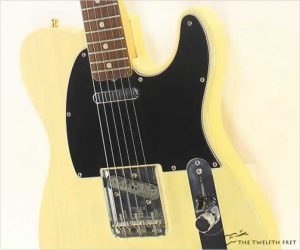
MORE →The Fender Telecaster Rosewood Fingerboard models appeared in September of 1959 as Fender introduced this wood to attract Gibson players. This was originally a flat-bottomed ‘Slab’ fingerboard glued to the flat top of the Maple neck, and the truss rod mounted from a channel underneath the fingerboard. In July 1962, Fender introduced new production processes to bond a thin layer of Rosewood to the curved top of a Maple neck blank, and this process is still used today.
This instrument has sold
MORE →